

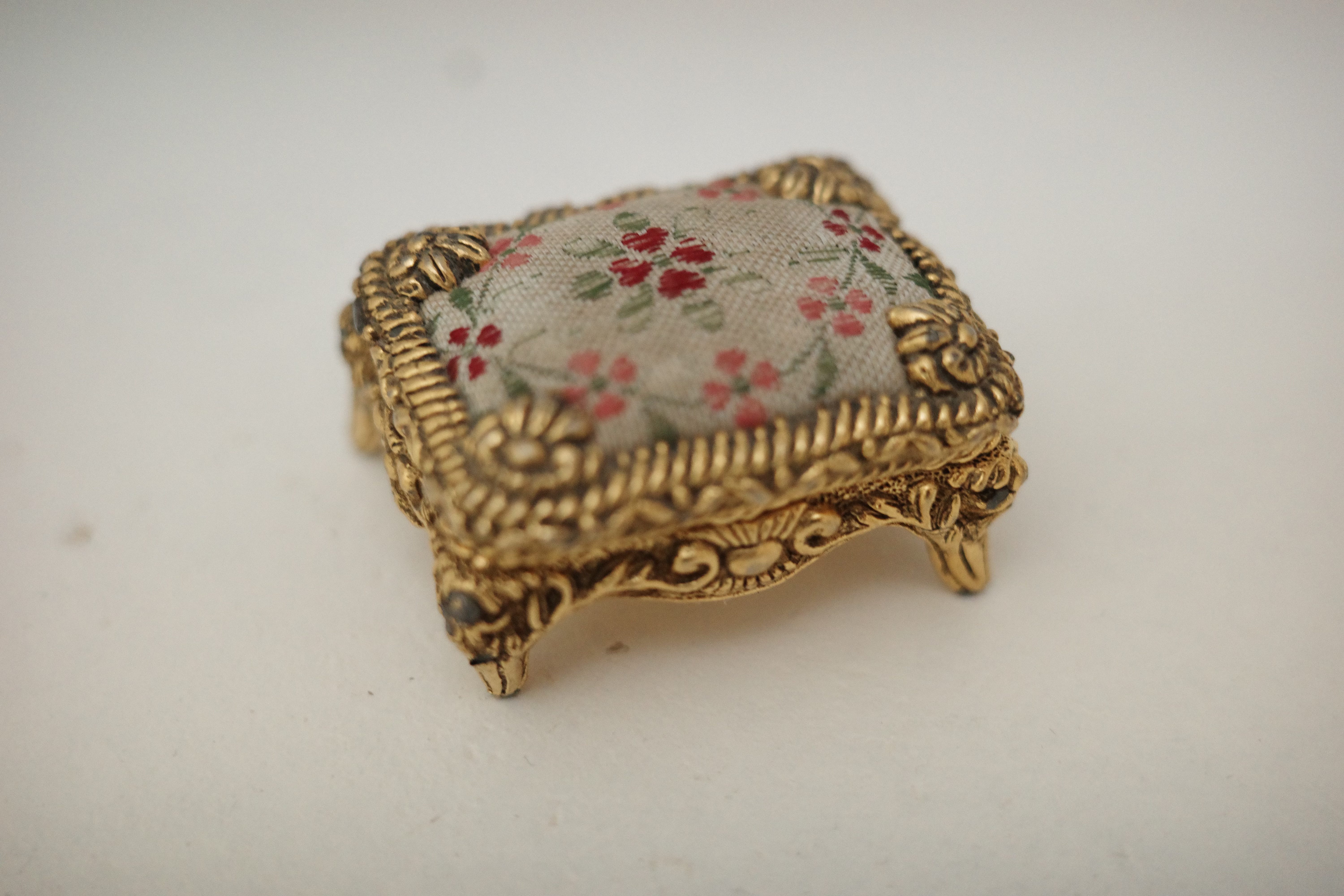
I have always loved a little thing.
My older brother once brought me home a tiny ornate footstool that he bought at a garage sale. I could hold it nicely between my forefinger and thumb. It had a white and pink and red brocade cushion and swooping tiny gold legs. The cushion was a hinged lid that snapped shut satisfyingly over a small compartment. It was maybe a relic of a doll house? Or used to hold sewing needles? A kind of pillbox?
Removed from its origins and context it floated through the world (or more soberly, in my pocket) nothing short of special, and much more potent than if it had been one amongst many other such items in a dollhouse, or an item of utility in a sewing basket. Oh, I did love that little thing.
It seems almost inevitable, then, that now that I make things, I have made that footstool several times over. First, in clay about the same size as it actually is, but without its lid it became more footed dish than doll-sized footstool.
I then cast that ceramic dish in bronze and it became both closer to and further from the thing itself. I replicated that version several times to hold different shaped eggs. The footstool now a very small kind of pedestal.
I have since updated that form to a larger size of footed ceramic rimmed trays to hold ceramic flower frogs and stands (after a fashion) for floral arrangements. The footstool now a kind of vessel.
The poet Richard Hugo’s book on poetics, Triggering Town, employs the theory that a poem’s foundation need not be a real physical place or a concrete thing, those are almost too hard or maybe (fear of all fears), too boring, to initiate a good poem. Instead, a triggering subject (or triggering town, as he names it) that animates you should be located internally -
“Your triggering subjects are those that ignite your need for words. When you are honest to your feelings, that triggering town chooses you. Your words used your way will generate your meanings. Your obsessions lead you to your vocabulary. Your way of writing locates, even creates, your inner life.”
I think of this often when making things. Finding some emotional center from which to work seems to help me make better things, or at least gives me more purpose and energy and ultimately makes work more satisfying. (I also believe that for me as Hugo lays out, the writing, the action, the doing helps to find the meaning. Best to get to work!)
But an object can be its own triggering town. A small, silly trinket - an object of fascination from childhood - can change shape after years of sitting somewhere in your mind, and now with clay in your hand, it can help build a new vocabulary. A vocabulary meaningful in a way truly unique - deeply personal, tying you to your childhood, but also completely up for grabs interpretation-wise all while having an obvious meaning dictated by its function and utility.
This opens up that grand possibility that, maybe, if you’ve done something right, your new object living out there in its utility, or in some unimagined capacity, in the use of a friend or a stranger, might fascinate, might capture someone else’s imagination and become a triggering town of its own.
I have always loved a little thing. A little thing can hold so much.